
Three Years Later, the Sinister Audio Trilogy Is Finally Complete. Here’s the Horror Story.
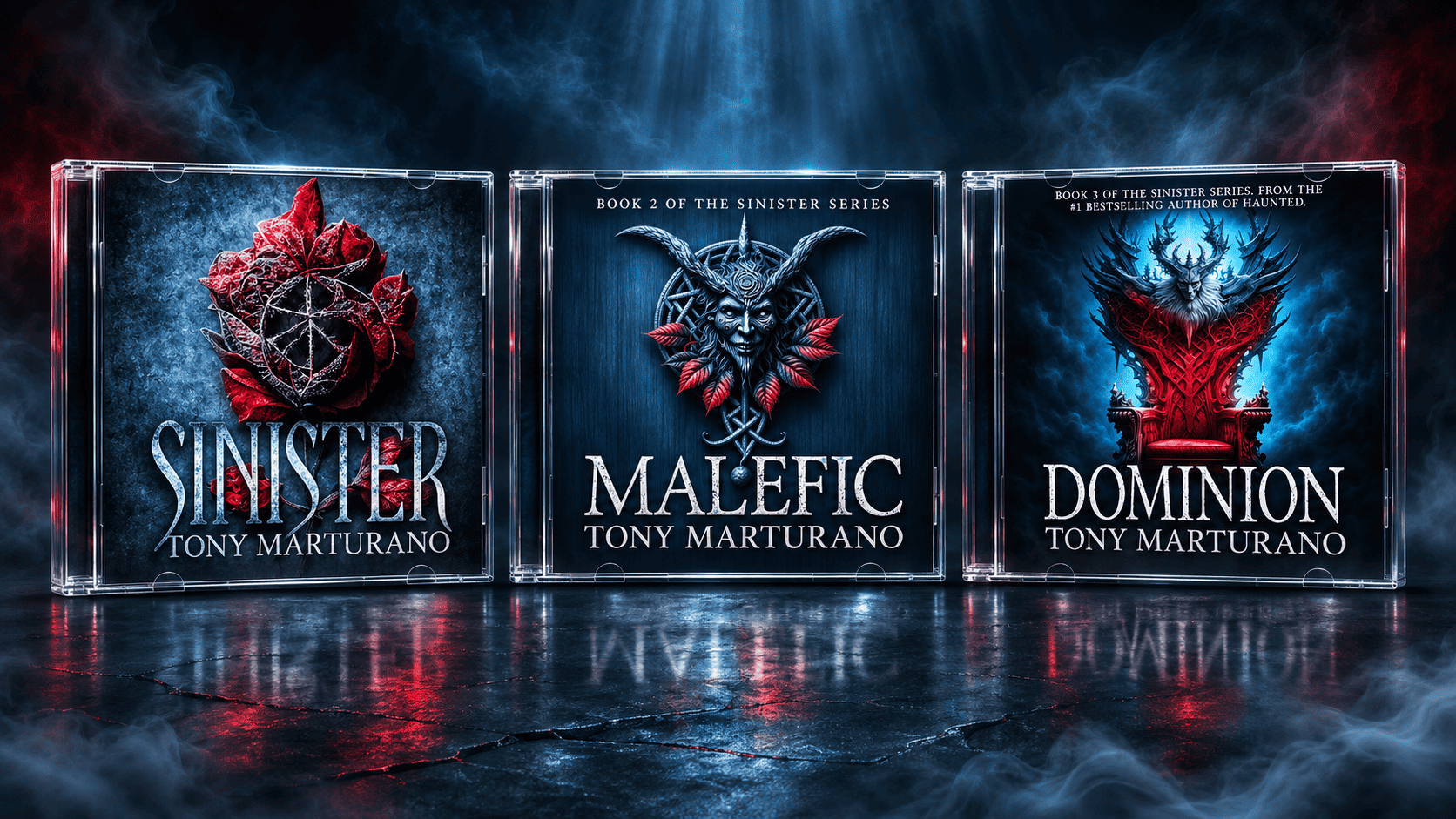
I write suspense. I hadn’t intended the publication schedule to become part of it.
I’m sorry things have been rather quiet here lately. Ironically, it’s been very busy on the publishing front, not least with the audiobooks and, of course, the new novel. More about that soon.
Right now, I have some very exciting news to share with you.
When Sinister arrived in 2023, readers quite reasonably expected Malefic and Dominion to follow in audiobook form. Some of you wrote to me. Some left comments. Some asked, with admirable patience, when books two and three were coming.
The honest answer is that they should not have taken three years. I write suspense; I hadn’t intended the publication schedule to become part of it.
The delay was never deliberate, and it certainly was not because I had forgotten the listeners who were waiting. I know that for some people an audiobook is not merely another format. It is the way they read—through preference, through circumstance, or because a printed page is not practically accessible to them at all.
For a long time, however, I was trapped in ways of producing audiobooks that either consumed an impossible amount of time, demanded too much compromise, or simply could not deliver the experience I wanted.
Some of you will have moved on by now and may no longer give a rat’s whisker what happened. Fair enough. But for those willing to return to the Sinister series, this is the story of why it took so long—and why I believe the result was worth the wait.

An audiobook should be a performance
I have always been closely involved in my audiobook productions. I do not think of them as somebody simply reading a manuscript into a microphone. The narrator is performing the story: its pace, tension, emotion, characters, accents and atmosphere.
That matters to me because I want the audiobook to be as immersive as the novel. My productions have a cinematic soundscape: sound effects and atmosphere carefully worked around the performances to draw you into the scene. That is part of the experience I want to give listeners, and it is why the first Sinister production was deliberately ambitious.
But that soundscape takes time to build. The effects have to be selected, placed, edited and mixed around the voices. I love what they bring to a story, but they do add a substantial layer of post-production to every audiobook.
After casting from hundreds of auditions, I chose a lead narrator and a separate male performer. The idea was to give the characters greater dramatic range. The difficulty was that the actors were not together in a studio. Like many audiobook performers, they recorded remotely in their own booths.
Bringing those separate recordings together proved far more time-consuming than I had anticipated. There was extensive cleaning and editing to do, and the second performer’s dialogue had to be worked into the main narration, often line by line. All of that contributed to the delays with the first audiobook.
We got through it, and I was proud of the finished Sinister production.
But when I turned to the production of books two and three of the series, Malefic and Dominion, I knew how easily two more productions could eat into my writing time. The challenge was to speed up production without losing the performances and atmosphere that mattered to me.
Book 1 of the Sinister series · audiobook excerpt
Enter Amazon
As it happened, Amazon invited me into its automated narration beta. At first, it looked like the answer.
What interested me was the prospect of drastically shortening production times. Instead of finishing a manuscript, waiting for it to be recorded and then working through the editing and post-production, I could see the possibility of preparing the editions in tandem: print, ebook and audiobook coming out together. For audio listeners, that would mean being able to join the story at the same time as everyone else.
The cinematic sound design would still need my time and attention. But a faster route through the narration would give me more room for that work while protecting the time I needed to write the next book. That was the appeal.
The programme was confidential at the time, so I could not talk about it while I was involved.
However, the technology wasn’t quite there. The automated narration I tested left a great deal to be desired, particularly in its intonation, emotional range and characterisation.
I waited for the programme to mature.
Then I waited some more.
Months became a year, then almost two. The voices did improve, but not enough—especially for Malefic, which travels through Italy. Pronunciation, accents and character performance are essential to making the listener feel present and immersed in that world. The results repeatedly fell short of what I was prepared to put in front of readers.
I later learned that distribution through the beta was restricted to the United States. It would not get the audiobooks to listeners in the UK nor the rest of the world. I had spent an extraordinary amount of time waiting for a route that could not serve a substantial part of my readership.
Amazon had not been the solution. It had become the waiting room.
A long-term solution
Around this time, I was approached by another company with a possible way forward. What it offered had the potential to help me finish Malefic and Dominion, and to release future audiobooks alongside their print and ebook editions, or shortly afterwards.
With an actor’s permission, the technology can now create a voice clone from recordings of their voice. That licensed reproduction gives us a voice we can direct throughout an audiobook, bringing different characters to life, conveying emotion and working on pronunciation across languages. I wanted performances that could carry an entire novel without turning it into a polished but lifeless automated recital.
We could work on how a line was delivered, how a character sounded, where the tension rose and where a quieter moment needed room to breathe. There would still be casting, careful listening, revisions and all the cinematic sound design I wanted to add.
That said, the technology was new and, while ahead of its time, it wasn’t quite ready for the demands of the productions we wanted to create. But we were determined to find a way to make it work for us.
Testing the process
I was not prepared to gamble Malefic and Dominion on enthusiasm alone.
We first proved the process on Treason, then pushed it further on The Hollowing. Those productions taught us how the voices held up across a whole novel, through emotional shifts, different characters and the inevitable moments when a voice decided to develop ideas of its own.
Only then did we return to the two books that had been waiting all this time.
Audiobook excerpt
Returning to Malefic
Casting still mattered. For Malefic, the narrator had to make the Italian names and dialogue sound natural, and give each character a voice of their own.
When the first chapters came back, I knew we had finally found what the Amazon experiments had never delivered. The narration drew me into the scenes, and the Italian dialogue sounded natural. It was the production I had imagined from the beginning.
Finally, Malefic, book two of the Sinister series, reached the end of principal recording.
Book 2 of the Sinister series · The Doorway
For listeners who have finished Sinister; this excerpt may reveal details from book one.
Dominion pushes the boundary again
Returning to Dominion, book three of the Sinister series, I was reminded how structurally ambitious the book is. Its locations and points of view shift; strands of the story develop on different sides of the water and eventually converge.
That invited us to go further.
We introduced another narrator for selected sections while retaining the main voice, allowing the production itself to reflect the book’s changing perspectives. Again, this was precisely the sort of long-form, multi-character work that supposedly sat beyond the technology’s comfortable limits.
And yet, working with the studio, we refined each narrator’s delivery and characterisation to achieve the performances the story needed. The result was two distinct voices, each bringing the characters to life in ways that were a joy to hear. More importantly, they gave readers the experience I had wanted all along without forcing me to choose between creative ambition and ever finishing another novel.
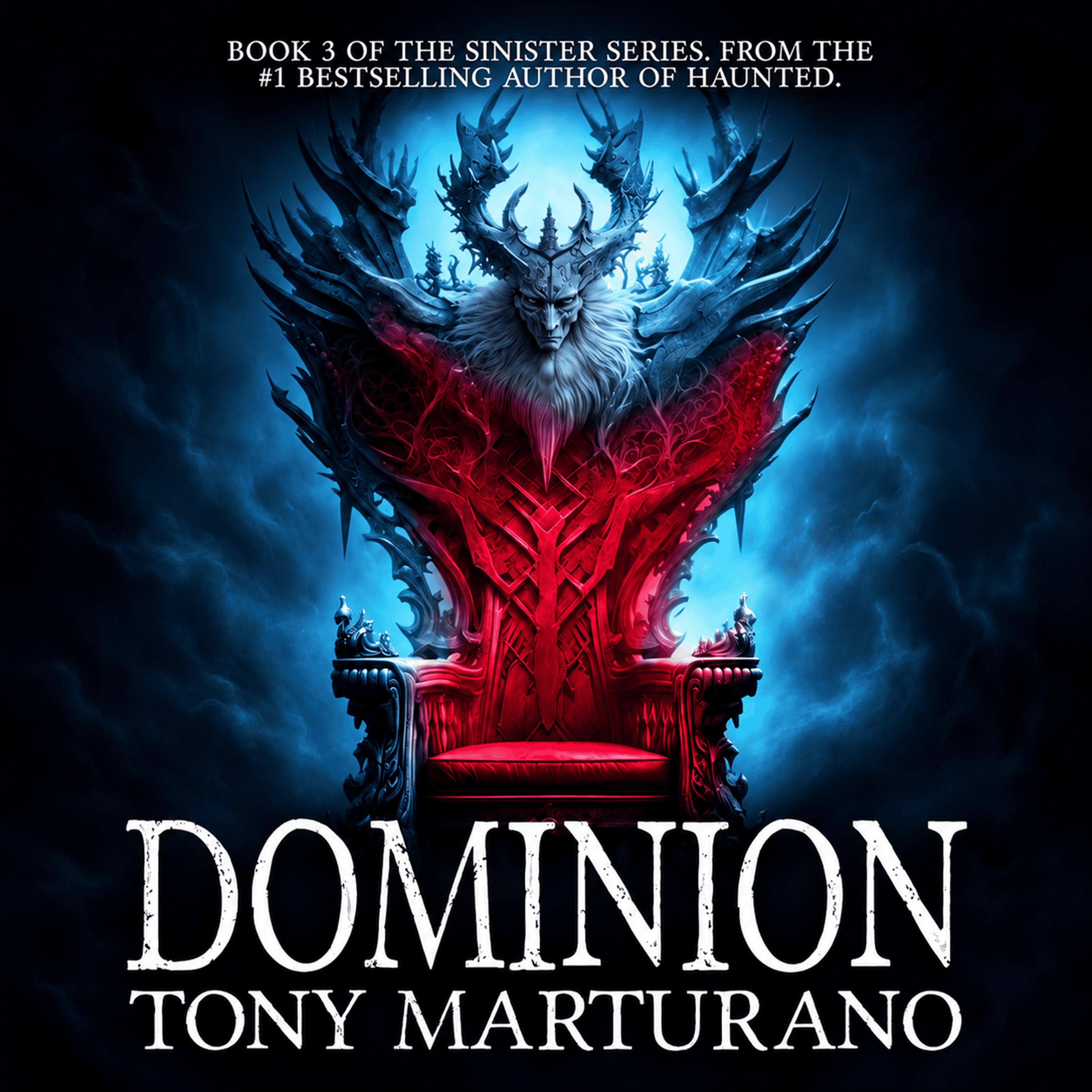
Book 3 of the Sinister series · audiobook excerpt
For listeners who have finished Sinister and Malefic; this excerpt may reveal details from the earlier books.
The trilogy is complete
On 23 November 2026, we signed off the final master of Dominion and delivered the audiobook to Google Play and Spotify.
So, finally, after three long years, the Sinister trilogy has a full audiobook line-up. All three audiobooks are now available from Spotify and Google Play. We’re also exploring bringing the audiobooks to Apple Books. The Kindle and print editions remain available from Amazon.
If you’re one of the people who waited for Malefic and Dominion, I am so very sorry it took this long. I hope you will come back to the series. Most of all, I hope these new narrators give you the experience I wanted from the beginning—not merely books read aloud, but immersive stories performed to entertain you.
That was always the point.
Next time, I would quite like the production story to be shorter than the audiobook.
Leaving exclusivity behind
The new production process has also changed how I think about subscriptions and distribution.
My earlier audiobooks were available exclusively through Amazon’s Audible service. That agreement has now changed. Those titles remain on Audible and are also available through Spotify and Google Play Books.
On Spotify, listeners with eligible Premium plans can use their included audiobook listening hours. On Google Play Books, all three audiobooks are £9.99 each at the time of writing. Buy and listen individually, with no subscription required.
At the time of writing, Audible’s standard submission process does not accept audiobooks made using third-party voice-cloning technology, whilst Amazon accepts this type of narration only through its own programme. That restriction keeps these editions of Malefic and Dominion off Audible. It understandably creates an awkward situation for listeners who prefer a subscription-based service such as Audible and want to use their credits.
Sadly, I cannot magic that restriction away. What I can do is make the books available more widely through retailers that will carry them, add further outlets where possible, and make the buying options clear.
A note about voice actors and the future
Voice cloning raises important questions for actors about permission, payment and control over how their voices are used, now and in the future.
My view is straightforward: actors should choose whether to license their voices, understand what they are agreeing to and be paid for that use.
Done properly, I believe this could create new opportunities, allowing an actor’s voice to take part in productions their diary might otherwise rule out. It could also make ambitious audiobooks possible where the time or cost of a traditional production would put them out of reach. That depends on respecting the actors and the agreements made with them.
With that, there’s nothing left for me to say but HAPPY LISTENING.
Leave a Reply